
Custom Silicone Molds for Polyurethane Resin
Polyurethane resin is not a synonym for epoxy. PU often has a short pot life, a real exotherm in thick sections, and a moisture sensitivity that epoxy buyers don't budget for. The RTV mold is still a resin master plus a room-temperature pour, but the pour/vent plan and the first prototype have to match *this* resin, not a generic “resin mold” Shore chart. A 3-minute pot life with no high-point vents leaves air in the face. A thick block with no jacket still sags 0.5–1.5 mm (and worse) while the PU kicks.
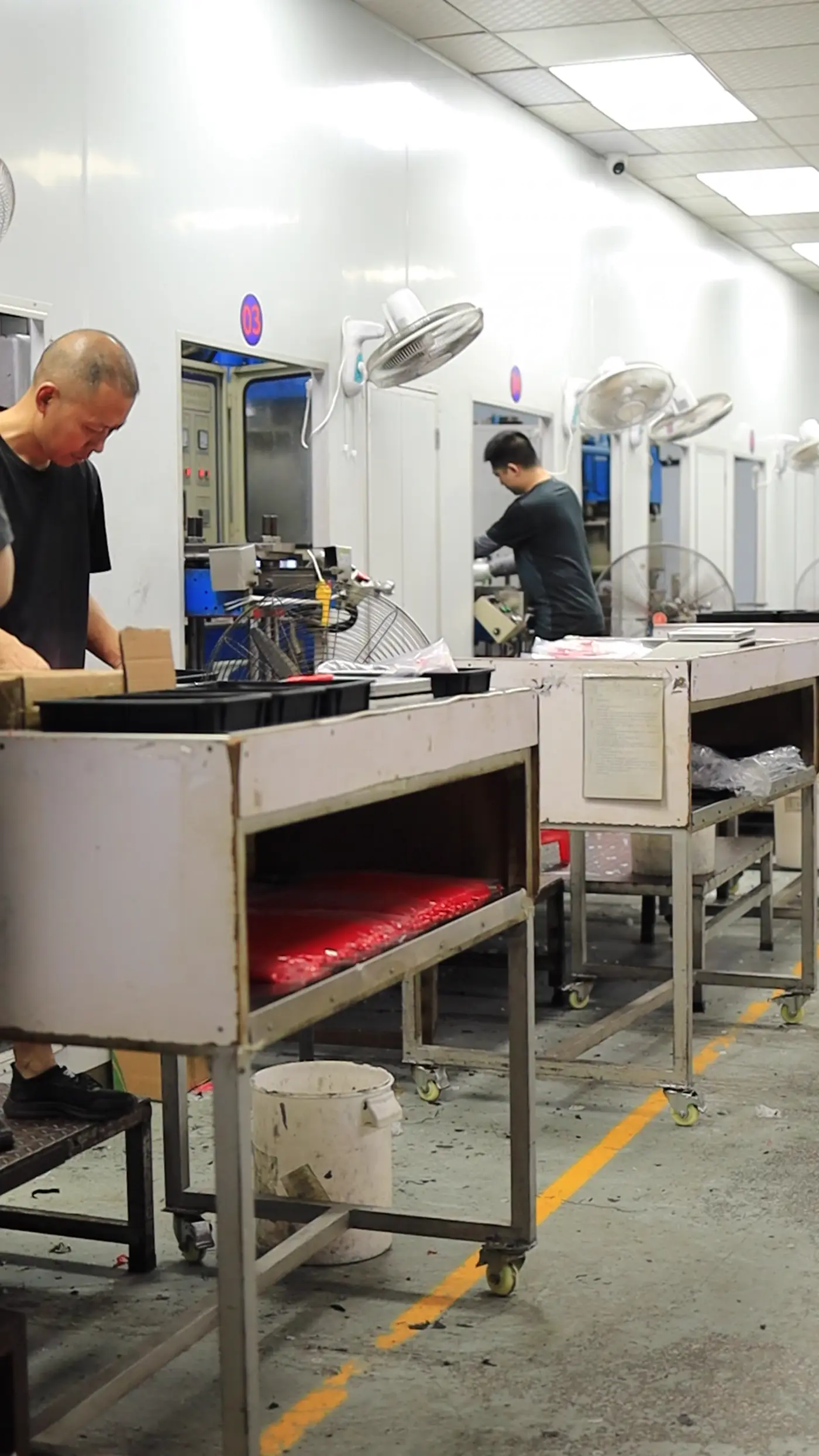
RUUIPON builds PU-casting RTV tools in Bao'an, Shenzhen (since 2018). Prototype 3–7 days after CAD lock; MOQ 20 molds per design. The sister epoxy / UV resin product page covers craft resin in general; this page is the PU-specific decision set. LSR cold-runner *part* tools are a different factory path.
Wet mass, undercut, jacket, Shore
Wet mass (and heat). PU density is lower than concrete, but a 180 mm solid figure is still a filled cavity that can bulge a soft skin, and the exotherm is a second load. Name filled grams and the thickest section. Unsupported sag about 0.5–1.5 mm is the conventional tray-scale number; a tall block without a jacket will print that belly into the part. Exotherm plus a tight glove also cooks the rubber sooner than a thin open-back coaster.
Undercut. Deep undercuts with a fast demold (you pop the part as soon as it's green so you can turn the mold) tear 10A skins if there is no split or plug. If silicone can peel slowly, open-back is fine. If the operator is racing a 5-minute gel, give them a keyed two-part and a plug for the locked pocket. See split lines and keys.
Jacket. Large or soft Shore 10A–20A PU molds still want a mother mold so the cavity doesn't balloon during the pour. The jacket must open as fast as the operator needs. Details: mother mold. Skipping the jacket because “resin isn't as heavy as concrete” is how you get a fat figure.
Shore. Cavity typically 10A–20A platinum for undercut peel, with the jacket holding size. Don't jump to 40A to “resist heat”—you'll load the undercut and still need support. Platinum shrink ~0.1–0.3%. Some PU systems and some tin RTVs fight; don't assume compatibility. A small cure-patch on a leftover skin is cheaper than a full recast. ISO 3302-1 is a rubber-part class; if a fit diameter is CTQ, measure the part from a jacketed mold, not the floppy cavity.
Common mix-up
Quoting a slow epoxy vent plan for a 3-minute PU. The gate and the high-point vents have to fill the cavity before gel, sometimes with vacuum or a pressure pot on the *casting*, not only on the RTV pour. Another mix-up: treating “platinum is compatible with everything” as a fact. Test the actual PU in a coupon.
Worked example: 180 mm PU figure, 4-minute pot life
Geometry: 180 mm standing figure, arms close to the torso (locked pockets), show face is the front, pour from the feet.
Resin: two-part PU, ~4 min pot life, modest exotherm, 280 g filled, pressure pot optional.
Tool family: finished master (print artifacts gone) → two-part platinum RTV Shore 10A–20A with keys, vents at the high points (head/hands), pour gate at the feet → plaster or printed jacket → compatibility coupon, then one full prototype, then MOQ 20.
Acceptance: complete fill with the real PU before gel; no air in the face; demold at the buyer's real time without tearing the arm pockets; jacketed sag in the typical 0.5–1.5 mm band or better; surface matches the approved master.
If pot life drops to 90 seconds, this mold needs a bigger gate, shorter fill path, or vacuum assist. Don't keep the 4-minute vent plan.
Failures you will actually see
| Symptom | How to confirm | Fix |
|---|---|---|
| Air in face, hands, or deep texture | Cut a short shot at gel time | High-point vents, faster gate, vacuum/pressure; don't just “pour slower” |
| Sticky or inhibited RTV against PU | Coupon cure on a scrap of the same skin | Change PU, barrier, or RTV grade; don't assume platinum is immune |
| Mold goes gummy after a few hot thick pours | Exotherm and cycle log | Thinner sections, longer cool, jacketed thin skin; recast schedule |
| Arms tear the mold on a fast pull | Watch demold at real time | Split/plug; stop yanking a one-piece glove |
| Figure is fat in the belly | Jacketed vs unjacketed pour | Mother mold; don't raise Shore first |
A photo that would prove the claim: vent exits with a small PU witness, coupon next to the production skin, jacket closed on a full pour. Ask for it on prototype validation.
Typical shop values
Reference values only. Confirm material-specific limits against the supplier’s technical data and agree project acceptance criteria before production.
| Item | Typical shop value |
|---|---|
| Cavity Shore | 10A–20A platinum RTV, jacket on large or thick pours |
| Mix | Platinum 1:1 or 10:1 by grade; vacuum degas until the foam collapses |
| Linear shrink | ~0.1–0.3% (platinum) |
| Loaded sag, unsupported | About 0.5–1.5 mm |
| Prototype | 3–7 days after CAD lock, plus a PU coupon |
| Production MOQ | 20 molds per design |
What to ask when you're buying
- PU system, pot life, and thickest section—not “resin.”
- Vacuum, pressure pot, or bench pour?
- Where are the high points in the pour orientation?
- Open-back, split, or plug for the locked pockets?
- Jacket for wet mass / belly, even though PU is lighter than concrete?
- Who owns the master and jacket, and is a recast of the skin included after heat wear?
We would not recommend treating PU as epoxy
We would not recommend a slow epoxy vent layout for a 3-minute PU. We would not skip the mother mold on a large wet PU block. We would not raise Shore A first to “fight exotherm.” We would not skip a compatibility coupon. We would not one-piece a pose with locked arms and a fast demold.
RUUIPON Mold Structure Decision:
- Open-back shallow PU part? - full-3D / locked arms -> Deep undercuts?
- Deep undercuts? - slow peel is acceptable -> Open-back RTV
- Deep undercuts? - fast demold cannot peel -> Two-part / plug
- Thick pour, soft Shore, or large wet mass? - tiny thin coaster -> Open-back RTV
- Two-part / plug -> Mother mold / jacket required
- Open-back RTV -> Thick pour, soft Shore, or large wet mass?
- Thick pour, soft Shore, or large wet mass? -> Pot life under ~5 min?
When this page is the wrong quote
Slow epoxy or UV craft pours with long working time belong on custom silicone resin molds. Brittle gypsum figures belong on plaster. Food-contact pastry is not PU. If the PU attacks every platinum coupon you try, stop and change chemistry—don't multiply 20 molds. High-volume silicone *parts* are an LSR/HCR quote.
PU resin RFQ — copy this
- PU brand/system if known; pot life; gel; demold time
- Filled grams and thickest section
- Vacuum / pressure pot / bench
- Pour orientation; show face
- Undercuts, arms, texture
- Master type and finish (master options)
- Jacket yes/no; Shore if already validated
- Compatibility coupon + full prototype in the *real* PU
- Quantity: prototype + production (MOQ 20)
- Ownership of master and jacket; recast after heat wear
- Current failure: air, sticky skin, belly, torn undercut
Send the STL, the PU data sheet if you have it, and pot life. [email protected] · +86 135 3006 2969 · Licheng Technology Industry Park, Xinhe Blvd, Shajing, Bao'an, Shenzhen.
Matched CTA: Send PU pot life, pour orientation, and undercut photos for a vent-and-jacket review. Contact / RFQ · prototype validation · resin molds.
FAQ
Why can't I use my epoxy mold for PU? You might, after a coupon. Pot life, exotherm, and moisture are different, so vents and cycle time often change. Don't assume the epoxy tool is a PU tool.
Do I still need a jacket if PU is lighter than concrete? On a large or Shore 10A–20A cavity, yes. Typical unsupported sag is about 0.5–1.5 mm. That's a fat belly on a figure.
How do I stop air in a 4-minute pour? High-point vents, a gate that fills the cavity before gel, and sometimes vacuum or a pressure pot. Pouring more slowly is usually the wrong advice.
Will PU heat kill the mold? Thick, hot cycles shorten skin life. A thin jacketed skin that you recast against the same master is the normal maintenance path. There is no universal cycle count.
Is platinum shrink the main size error? Typical platinum linear shrink is 0.1–0.3%. Belly from a missing jacket is usually larger. Measure a jacketed real-PU cast, not the empty floppy cavity.