
custom silicone soap molds
Custom Silicone Soap Molds
- DFM
- Before tooling
- Process
- CP / HP / MP
- Layout
- Bar / loaf / tray
- Logo
- At real scale
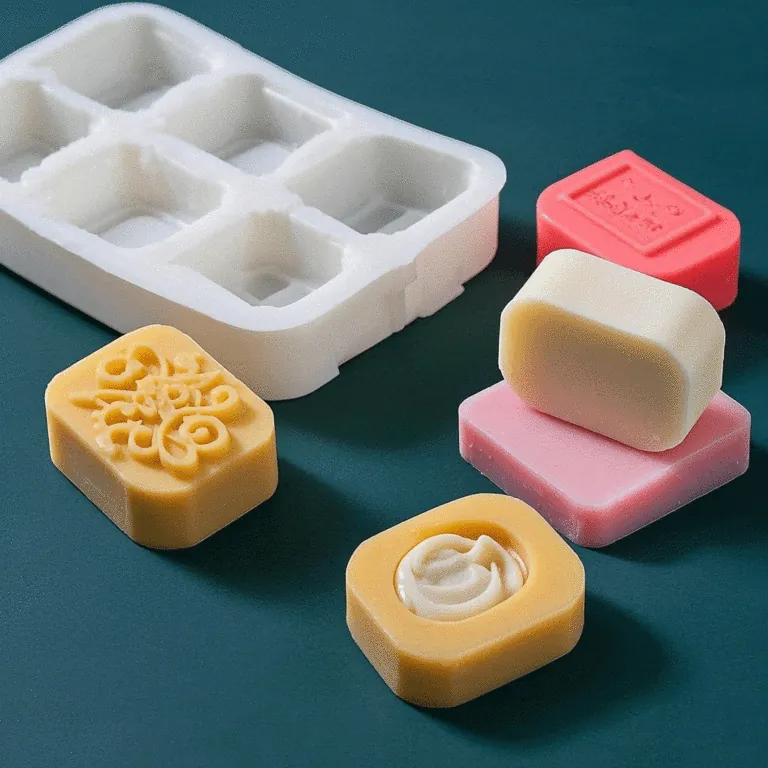
A soap mold follows the soap process and the finished bar. Cavity count and one Shore number do not decide the tool.
Bar, loaf, logo, and multi-cavity trays are different jobs. Name which one you pour. The manufacturer overview is the RTV quote path. A single hand-held cavity is not a production sheet: one-cavity soap peel.
Send your soap process, finished dimensions, target weight, artwork, cavity target and production quantity so the mold structure can be reviewed before tooling.
Design Guide: Custom Soap Mold Design Guide
What Kind of Soap Mold Do You Need?
Individual Bar Cavities
Useful when each bar should leave the mold close to its final shape.
Review:
- bar dimensions;
- target weight;
- logo/texture;
- release;
- cavity count;
- tray support.
Loaf Mold or Liner
Useful when the soap is cast as a larger loaf and cut later.
The buyer should define:
- inside loaf dimensions;
- batch size;
- support box/frame;
- removal method;
- cutting process.
Decorative / Full-Shape Soap
Complex 3D forms or deep undercuts can require a split, slit, plug/core or another release strategy.
Multi-Cavity Production Tray
Cavity count must be balanced with:
- filled weight;
- tray span;
- support;
- operator handling;
- demolding access.
Cold Process, Hot Process and Melt-and-Pour Are Different
The soap process affects the mold requirement.
Tell us whether the project is:
- cold process;
- hot process;
- melt-and-pour;
- another formulation/process.
Relevant differences can include:
- temperature;
- fresh soap softness;
- demolding time;
- fragrance/additives;
- formula compatibility;
- cleaning.
Do not use a food-contact specification as a substitute for soap-process compatibility.
Soap molds are not automatically “food-grade tools” simply because a platinum-cure silicone exists.
“Very Soft Silicone” Is Not a Complete Specification
Buyers often ask for a very soft mold because they want easier demolding.
But softer is not always better.
The mold must also:
- hold the bar geometry;
- remain stable when filled;
- support logo/detail;
- resist local tearing;
- remain practical for the operator.
Material selection should consider hardness together with tear behavior, geometry, wall/support structure and the actual soap-release process.
Target Bar Weight Needs the Right Reference
For cavity bars, tell us whether the target refers to:
- fresh poured weight;
- demold weight;
- cured/sale weight.
Cold-process soap can lose water during cure, so the cavity should not be designed from a final retail weight without understanding the formulation/process.
Where weight is important, validate the real soap before repeating a large production layout.
For loaf molds, bar weight also depends on the cutting plan.
Logo and Surface Detail
For branded soap, send:
- vector artwork where possible;
- desired logo size;
- raised or recessed result on the finished bar;
- surface texture;
- actual bar dimensions.
Deep or very fine features can:
- hold soft soap;
- damage letters during release;
- create weak soap edges;
- increase mold stress.
Approve the logo at real size and test with the real process where branding is critical.
Multi-Cavity Layout and Mold Size
A request such as “12–20 bars in one mold” needs more than the bar dimensions.
Review:
- cavity arrangement;
- edge border;
- filled tray weight;
- web/support;
- operator reach;
- table/rack dimensions;
- demolding sequence.
The largest possible tray is not automatically the most productive tray.
A smaller supported tray can be easier to fill, move and demold consistently.
Material Compatibility
Provide:
- soap process;
- oils/base if relevant;
- fragrance;
- colorants/additives where relevant;
- maximum temperature;
- cleaning chemistry.
The selected silicone should be reviewed for the actual formulation/use.
Do not describe a generic “lye-resistant” grade as universal evidence without identifying the selected material.
Manufacturing Route
A custom soap mold can be developed by different manufacturing routes depending on:
- geometry;
- quantity;
- repeat-volume;
- tooling economics.
For custom flexible molds, an RTV-cast mold route may be suitable.
For higher-volume finished silicone trays, HCR/HTV compression molding may be reviewed where appropriate.
The buyer should describe the product and order plan rather than assuming the route.
Prototype With the Real Soap
A useful prototype can confirm:
- bar dimensions;
- target weight reference;
- logo/detail;
- release;
- local tearing/stress;
- tray stability;
- cleaning;
- operator handling.
For cold-process or fragrance-heavy projects, testing the actual formula is more meaningful than assuming another soap behaves the same way.
What Affects the Quote?
- bar/loaf geometry;
- overall mold size;
- cavity count;
- silicone consumption;
- support box/frame or shell;
- new CAD/modeling;
- logo/detail;
- RTV vs compression route;
- prototype/testing;
- production quantity;
- packing/shipping.
Commercial baseline: Standard MOQ is 20 pcs. If CAD/3D modeling is required, the standard modeling fee is USD 50. Tooling, unit price, lead time and shipping are confirmed for the specific project.
Soap Mold RFQ Checklist
Send:
- CP / HP / melt-and-pour / other process;
- bar or loaf dimensions;
- target weight and when it is measured;
- logo/artwork;
- cavity-count target;
- maximum mold/tray size;
- preferred demolding method;
- support box/frame information;
- prototype and production quantity;
- material/formula conditions that matter;
- target date and destination.
Frequently Asked Questions
Can you make one mold with 12–20 soap cavities?
Potentially, yes. The layout should be reviewed for filled weight, tray stability, operator handling and demolding rather than cavity count alone.
Should the silicone be very soft?
Only if the overall design still holds the product and survives the release process. Hardness is one variable, not the complete specification.
Can you design a mold from a target soap weight?
Yes as an initial engineering target, but specify whether the target is fresh, demolded or fully cured weight and validate the actual formula.
Can you mold a logo into the soap?
Yes. The logo geometry should be reviewed for fill, release, bar strength and the real soap process.
Does a soap mold need FDA/LFGB food-contact documents?
Not simply because it is a soap mold. Define the actual regulatory/customer requirement instead of applying food-contact language by default.
Soap mold clip
Custom soap cavity. Do not treat soap trays as FDA/LFGB food-contact tools.
Custom soap mold to your design
Cold-process peel on a branded bar cavity. Food-contact claims do not apply to soap trays.