
Depositor-compatible gummy molds: pitch from the machine, not a photo
A depositor-compatible gummy mold is an RTV tray whose cavity centers match *your* nozzle pitch and whose sheet stays flat in a nest - not a catalog bear sheet that "looks like" a Baker Perkins photo. Don't freeze pitch from a picture. Send the machine drawing: nozzle count, center-to-center pitch, indexing direction, and maximum tray envelope. Estimate cavity volume from the target gummy weight and the density of the actual formulation. Verify nozzle alignment, tray support and piece weight across both center and outer cavities using the intended filling process. Loaded deformation can affect alignment and fill consistency; the amount must be measured on the actual tray. RUUIPON pours platinum RTV depositor trays in Bao'an since 2018: photos, sketch, or CAD, then a 3D-printed pattern, often a temporary silicone flip, a resin production mother, then batch RTV. Prototype in 3-7 business days after CAD lock. MOQ 20 pcs/design. 21 CFR 177.2600 is extraction of the article, not an FDA-approved factory. Steel high-volume confectionery *part* tools are quoted here as HTV products or molds, or as a different LSR-tool RFQ - ask us. The gummy hub is custom silicone gummy molds.
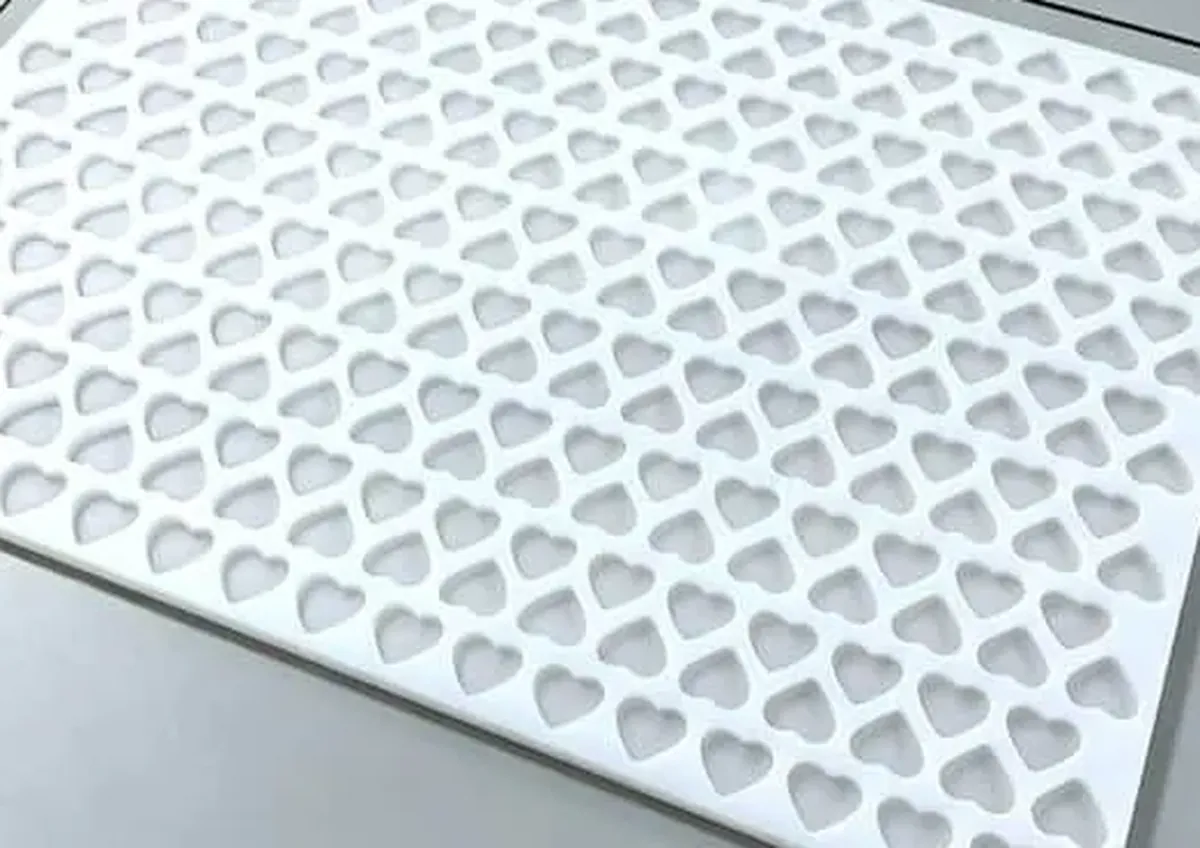
Pitch, nest, and tray envelope - lock these before cavity art
Send STEP/STL of the pocket, target grams, pectin vs gelatin, nozzle count and pitch *from the OEM drawing*, tray outer limit, registration features the machine expects, and whether a rigid nest already exists. More cavities are not automatically better.
We dry-align a prototype against a paper or metal template of the pitch before anyone multiplies trays. If the machine is still unknown, stay on a hand-fill or flood-and-scrape tray - flood-and-scrape gummy molds - until the drawing arrives.
Pectin stretch vs nest
Sticky pectin stretches a soft tray. Typical production trays sit around 20A-30A with a rigid nest; a 10A-20A skin is for undercut peel, not for walking a loaded sheet across a kitchen. Don't raise Shore A first to "fix stretch" if the real issue is a missing nest. Check tray support alongside deposit volume, nozzle alignment and process conditions when outer-row weights differ. Weigh every cavity on the prototype.
When this depositor advice does not apply
Hand dump and flood-and-scrape don't need a machine pitch. If you need high-volume steel confectionery *part* tools or LSR/cold-runner silicone toys in the same outline, stop here and quote an HTV product RFQ here. A one-cavity artisan gelatin dump can skip a production jacket. Geometry can override quantity: a negative-draft ear still needs a split or a fillet at 80 dumps.
If you only have photos, custom 3D modeling is USD $50 when that scope applies.
Depositor RFQ to copy
- Process: platinum RTV tray (not tin; not HCR/LSR substitution)
- Target grams (e.g. 4.0 g) and pectin vs gelatin
- Machine: make/model if known; pitch from the drawing, not a photo
- Nozzle count; indexing; max tray envelope; nest/frame yes/no
- Destination market; 177.2600 / LFGB
- Custom 3D modeling: USD $50 when that scope applies
- Quantity: prototype, then MOQ 20 pcs/design
- Acceptance: dry pitch check; weigh every pocket; outer-row vs center
Send photos, a sketch, or CAD, target 4.0 g, formula family, and the depositor drawing to contact ([email protected] / +86 135 3006 2969). Licheng Technology Industry Park, Xinhe Blvd, Shajing, Baoan.
Matched CTA: Send the depositor drawing (pitch and envelope) plus target grams - not a photo of another factory's tray, and not a generic free quote.
Skip freezing Baker Perkins pitch from a photo
Skip guessing nozzle centers from a catalog bear sheet. Raising Shore A first will not hide a missing nest. 177.2600 is not an FDA-approved factory. LIM runner math does not belong on a pectin slab. Steel high-volume path → an HTV product RFQ here.
RUUIPON Mold Structure Decision: pitch from the machine drawing. Flat nest? open-back sheet in a jacket. Deep mascot undercuts that won't peel? fillet, split, or core. Soft skin or wet dump? mother mold before you add pockets.
- Pitch from machine drawing? - no / photo only -> Don't freeze pitch; wait for drawing
- Pitch from machine drawing? - yes -> Jacket keeps sheet flat?
- Jacket keeps sheet flat? - no -> Nest / thicker border first
- Jacket keeps sheet flat? - yes -> Dry-align, then weigh every pocket
- Dry-align, then weigh every pocket -> Outer-row weights differ?
- Outer-row weights differ? - yes -> Nest / thicker border first
- Outer-row weights differ? - no -> Lock Shore and recast master
- Depositor gummy tray -> Need steel high-volume parts?
- Need steel high-volume parts? - yes -> Ask us: steel or LSR part tool, not this RTV tray
Typical shop values
Reference values only. Confirm material-specific limits against the supplier’s technical data and agree project acceptance criteria before production.
| Item | Typical shop value |
|---|---|
| MOQ | 20 pcs/design after sample approval |
| Custom 3D modeling | USD $50 when that scope applies |
| Prototype | 3-7 business days after CAD lock |
| Mix | Platinum 1:1 or 10:1; vacuum degas |
| Cavity Shore | 20A-30A production tray; 10A-20A skin only if undercuts need peel |
| Platinum shrink | About 0.1-0.3% after full cure |
| Loaded-tray edge sag without a jacket | About 0.5-1.5 mm |
| Target piece | 4.0 g from volume x formula density |
| Outer-row vs center if tray sags | Measure center and outer cavities on the actual tray |
| Pitch | From the OEM drawing - not a frozen catalog photo |
FAQ
Can you copy pitch from a photo of our current tray? We can start a conversation. We will not freeze production pitch from a photo. Send the depositor drawing or a measured template.
Why did outer-row gummies weigh more than the center? The sheet sagged under load. Weigh every cavity, then add a nest or shorten the span before you add cavities.
Is 21 CFR 177.2600 the same as an FDA-approved factory? No. It's extraction of the finished rubber article.
When should I move to steel? When RTV trays and recast cost more than a steel confectionery tool. That's a different RFQ here as an HTV product RFQ.
Do I need a prototype before MOQ 20? For a new depositor pitch, yes. Dry-align, then deposit real formula. Multiplying an unweighed tray multiplies a fill-weight miss.