
1-Cavity vs 8-Cavity RTV: How Pockets Cut Dump Price
An 8-cavity RTV tray does not cut dump price by eight. It cuts pour time per piece and raises jacket, sag, scrap, and recast. Run the dump math.
 Kyler Yang · Founder8 min read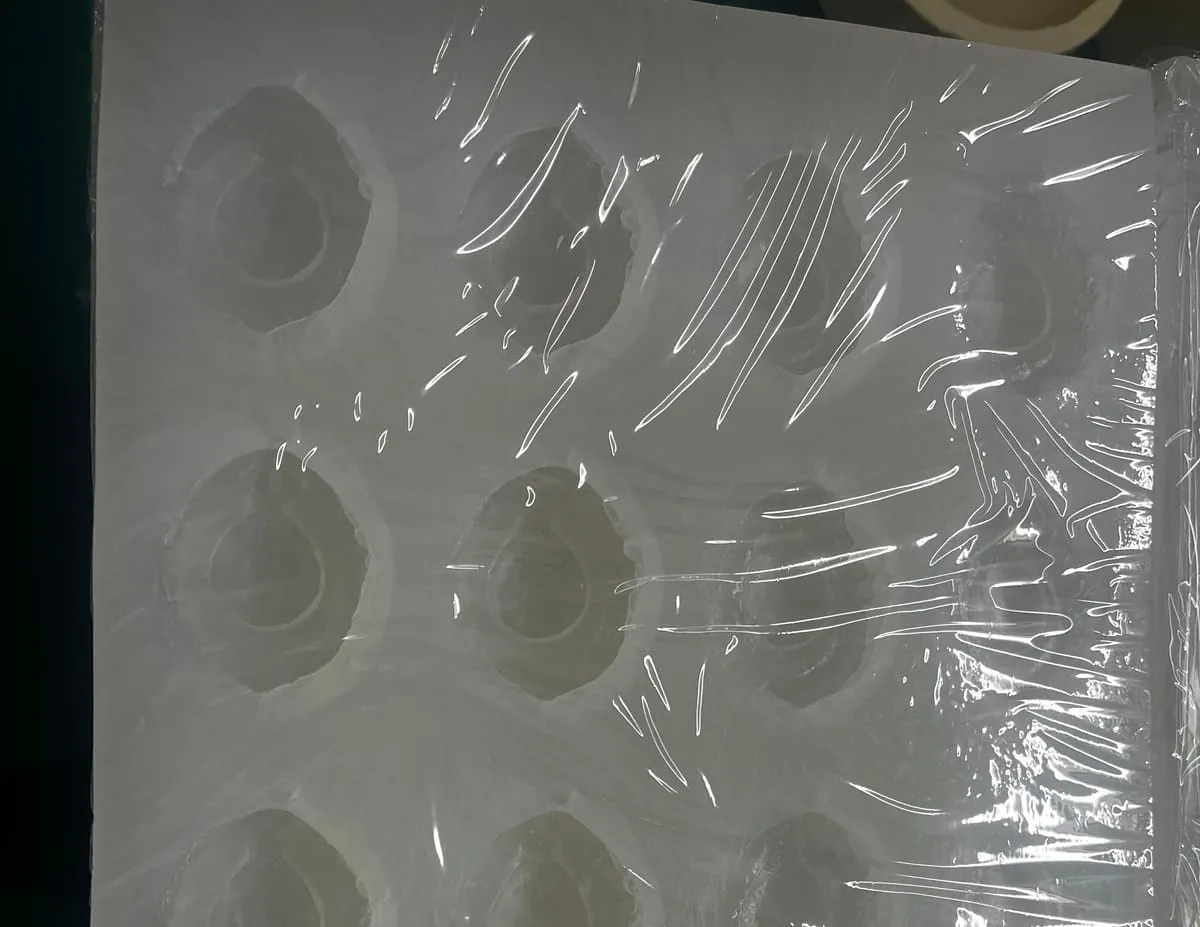
If you're sizing a custom RTV mold, eight pockets per pour cut bench hours. They do not divide the invoice by eight.
Cavitation is a throughput lever. Dump compound per piece is almost unchanged. Sag risk is multiplied. Balance can throw away whole pours. The only number that scales near-linearly is how many impressions you get each time the operator peels, *if* every pocket is good.
A 1-cavity RTV tool is a process lab that can also ship dumps. An 8-cavity LSR cold-runner tool is a different machine on a parts RFQ. Do not paste that spreadsheet onto a chocolate slab.
What 1-cavity is paying for, honestly
You pay less rubber, less jacket area, less tryout. Cycle time is the full pour+set+peel for each dump. Operator attention can be high without wrecking the P&L. Scrap is one pocket at a time. Engineering changes hit one master.
Dump price at low volume is dominated by setup and mold amortization, not by the fact that the tray makes one. Adding cavities before those two shrink is how you own a large, idle sheet.
Use 1-cavity when: design is young, annual dumps will not keep an 8-cavity fed, the pocket is large relative to the jacket, or the peel is already a fight.
Common mix-up: jumping 1 → 8 because a spreadsheet divided by eight
The first article comes back with two pockets pretty and two pockets hungry. Extra cavities need a flat mother mold and even deposit. Crowding a sheet isn't output.
ISO 3302-1 M2 on an 8-cavity sagging tray is a wish. It is a drawing class, not a cavity-count spec.
What 8-cavity is actually buying
Eight impressions per pour means, in a perfect world, roughly one-eighth the bench hours for the same count. That is the conversion win.
What you also buy:
More master and more jacket. Eight pockets, eight last-fill vents, a sheet that must stay flat, more keys. An 8-cavity platinum skin is not “8 × 1-cavity.” It is a different handling problem.
Balance. The dump will take the easy pocket. Family tools (different pockets in one tray) are worse. One weak pocket can force you to skip it, and then you own a 7-cavity with 8-cavity sag geometry.
Scrap geometry. A short in one pocket can scrap the pour or force a sort. Start-up pours waste eight times the dump. A 2% pocket-level defect rate is not a 2% pour-level rate if defects cluster. Outer-row 3–6% heavy vs center is sag, not “8× efficiency.”
Trim. Eight flash lines per pour. If keys are imperfect, you hired eight trims.
Recast. One torn letter on a 16-cavity sheet parks the SKU. Two 8-cavity twins let you run while one skin recasts.
MOQ and batch physics. You will not want to set up an 8-cavity depositor cell for 80 dumps. The shop will set a batch floor that protects their changeover. Dump price looks pretty at 50,000 and hostile at 500.
The pour math without a fake quote
Let *T* be pour+set+peel time (set-dominated for chocolate; extra cavities do not shorten set of a thick dump). Let *n* be cavities. Bench time per good dump ≈ *T* / (*n* × yield).
If yield is 0.98 on a 1-cavity and 0.90 on an 8-cavity because two pockets sag, the 8-cavity is not 8×. It is 8 × 0.90/0.98 ≈ 7.3× impressions, minus extra sort labor.
Rubber waste: a 1-cavity wastes one mix skin. A poorly jacketed 8-cavity can waste a tree of dump on the outer row plus a too-thick jacket wall. Put dump mass per good piece on the quote.
Mold amortization: if the 8-cavity tray costs on the order of several times the 1-cavity (not eight times, not two times; it depends on whether you duplicated masters or built one sheet), you need enough lifetime dumps for that delta to fall below the bench-time savings. Thick dumps (long *T*) love cavitation. Very low annual volume never pays it back.
What to ask when you're buying
- 1-cavity and 4-cavity (and 8 only if volume is serious) on the same dump and flash spec?
- Jacket construction and how the sheet stays flat?
- Assumed yield; first article weighs every pocket?
- Batch / MOQ implication of that cavitation?
- Recast plan if one pocket tears?
Worked example: 1 then 8 then two 8s
A 22 mm bear, 4.0 g, food-contact, heading toward ~10,000 dumps a month. First tool: 1-cavity platinum 10A–20A, mix 1:1, vacuum degas, jacket, ten peels. Then 8-cavity, weigh every pocket. Edge sag 0.5–1.5 mm fixed before copying. Two 8-cavity twins beat a crowded 16. A parallel 8-cavity LSR quote was press-hour math for a toy.
When this article is the wrong quote
If you actually need 8-cavity LSR part tools, runner waste and valve gates belong on a parts OEM pack. A tiny artisan 1-cavity can skip this. Geometry can override quantity: one deep 40 mm hollow is still a core at 8 cavities.
Related reading: custom RTV molds, balancing multi-cavity pours, unit price 100 vs 10k, gummy trays.
2- and 4-cavity: the unglamorous winners
For custom RTV, 2-cavity and 4-cavity are often the adult answers.
- 2-cavity: almost 1-cavity simplicity, a real cut in bench hours, still sane for moderate batches.
- 4-cavity: where many frozen food pockets live, if the jacket can stay flat.
- 8-cavity: when the pocket is small, the dumps are real, the peel is easy, and you have a spare skin or a twin.
Finish: eight polished cosmetic pockets is eight polish hours on the master. Texture the same.
Scrap: never assume the 1-cavity scrap rate. Require a fill-weight map in tryout. If the shop will not weigh eight dumps from one pour, they cannot claim 8-cavity economics.
RFQ: “Do not quote 8-cavity as a unit-price trick. Show 1-cavity and 4-cavity stacks at our real batch size. 8-cavity only if annual dumps and recast plan are stated.”
Send pocket STEP, target fill-weight, and monthly dumps. We will mark 1 vs 4 vs 8 and whether two smaller trays beat one crowded sheet.
We would not recommend buying 8 cavities to decorate a quotation
We would not recommend qualifying only the hero pocket. We would not skip the jacket and then claim 8×. Raising Shore A first is the wrong fix for hungry pockets. We would not paste LSR runner math onto a chocolate slab.
RUUIPON Mold Structure Decision: extra pockets after freeze, on a jacket that stays flat. Flat back? open-back sheet. Deep undercuts that won't peel? split or core — extra cavities don't remove a lock. Soft 10A–20A or wet dump? mother mold before you add pockets.
flowchart TD
  A[Want 8 cavities?] --> B{CAD frozen?}
  B -->|no| C[1-2 cavities only]
  B -->|yes| D{Jacket keeps sheet flat?}
  D -->|no| E[Fix mother mold first]
  D -->|yes| F[Weigh every pocket on FA]
  A --> G{Need LSR parts?}
  G -->|yes| H[Stop: different part RFQ]
Typical shop values
Caption these as typical shop values, not a named lot.
| Item | Typical shop value | | --- | --- | | Mix | Platinum 1:1 or 10:1; vacuum degas | | Cavity Shore | 10A–20A skin with rigid jacket | | Platinum shrink | About 0.1–0.3% | | Loaded-tray edge sag without a jacket | About 0.5–1.5 mm | | Outer-row vs center if tray sags | Edge often 3–6% heavy | | Yield example | 0.98 on 1-cavity vs 0.90 on a sagging 8-cavity is not 8× |
FAQ
Does an 8-cavity RTV tray cut dump price by eight? No. It cuts bench hours per piece if every pocket is good. Compound per piece barely changes. You also buy more jacket, multiplied sag risk, start-up waste times eight, and a higher honest min batch.
Why can a small pocket-level scrap rate wreck 8-cavity math? Bench time per good dump is cycle divided by cavities times yield. If two pockets sag, you do not have 8× impressions. A short in one pocket can scrap the pour or force a sort. Never assume the 1-cavity yield on eight pockets.
When are 2-cavity and 4-cavity the better buy than 8? Custom RTV often lives there: almost 1-cavity simplicity with a real cut in hours, still sane for moderate batches. Jump 1 to 8 because a spreadsheet divided by eight is how first article returns hungry pockets. 8-cavity belongs when the pocket is small, dumps are real, peel is easy, and a spare skin exists.
Why is an 8-cavity "Class 105" RTV a contradiction? Prototype construction with a production layout. High cavity counts belong on a jacket that can hold fill-weight. Eight cosmetic pockets are also eight polish hours on the master.
What must tryout weigh before anyone claims 8-cavity economics? Fill-weight per pocket, a short-pour map, and a flash map. If the shop will not weigh eight dumps from one pour, they cannot claim the conversion win. Quote 1-cavity and 4-cavity at your real batch size; 8 only with annual dumps and a recast plan stated.
Ready to order custom silicone molds?
Free quote for OEM/ODM projects. MOQ 20 · Prototype 3-7 days · FDA/LFGB available.