
Pour-On vs Brush-On RTV Silicone Mold Skins | RUUIPON
Brush-on is a detail coat plus a pour, not a cheaper drum. Pour-on fills a box in one shot. When each wins, typical shop waste, MOQ 20, $50 CAD when it
 Kyler Yang · Founder7 min read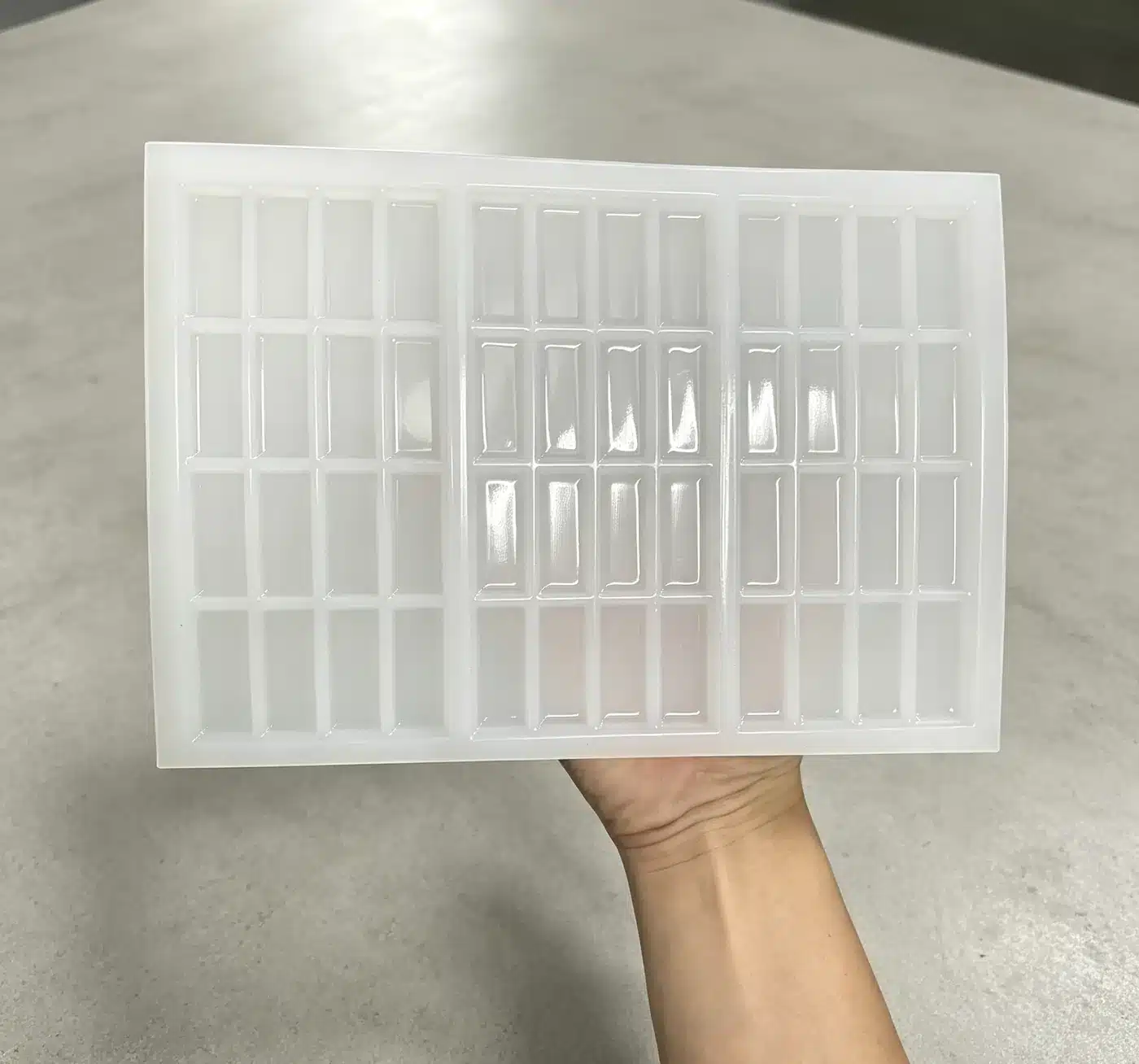
A pour-on RTV mold is mixed, degassed, and poured into a box until the master is buried. A brush-on (or "glove") mold starts with a detail coat on the master — thixotropic A/B stippled into texture — then a thicker coat, then usually a jacket. Brush-on is not a cheaper drum. It is a face-first sequence for vertical walls, deep texture, and masters that cannot live in a leak-tight box. Pour-on is the default when the master sits in a flask and you want a uniform block or an open-back tray.
RUUIPON runs both sequences in Bao'an / Shajing since 2018. Prototype 3–7 business days after CAD lock. Production MOQ 20 pieces per design. Simple 3D is USD $50 when that CAD scope applies. Platinum mix 1:1 or 10:1 by weight; shrink after a full cure typically about 0.1–0.3%. Molded silicone *parts* are not this page — send those as an HTV product RFQ here.
Does not apply when you already have a compression or LSR steel tool and you want a "brush-on" repair of a cavity. Steel is recut, not painted with RTV. It also does not apply to caulk-tube "one-part" DIY skins — we would not spec those for production or food.
Detail coat is a face, not a budget hack
The detail coat is the only rubber that will ever see the master. If you whip air into that coat, the face is craters. If you starve a serif, the logo is a hole. If you skip vacuum on a pour-on and the box is deep, bubbles still rise — but they often park on the face you care about.
Brush-on wins when:
- The master is vertical or already mounted on a wall (architectural panel, statue).
- A box would waste kilograms of gum around a tall, skinny part.
- You need a thin 10A–20A skin plus a mother mold anyway.
Pour-on wins when:
- The master is a tray, a bar, a small figurine you can box.
- You need a uniform Shore through the section.
- Keys and a split are easier to pour than to laminate.
A common failure is brushing one thin coat, calling it done, and dumping epoxy into a 0.5 mm glove. The skin tears. Brush-on still wants thickness *or* a jacket. See when you need a mother mold.
- Can it sit in a leak-tight box? - yes -> Pour-on after vacuum
- Can it sit in a leak-tight box? - no vertical or huge -> Detail coat, then body coat
- Pour-on after vacuum -> Need a split?
- Detail coat, then body coat -> Jacket the glove
- Need a split? - yes -> Keys in box or jacket
- Need a split? - no open-back -> Tray pour
- Jacket the glove -> Witness dump
- Keys in box or jacket -> Witness dump
- Tray pour -> Witness dump
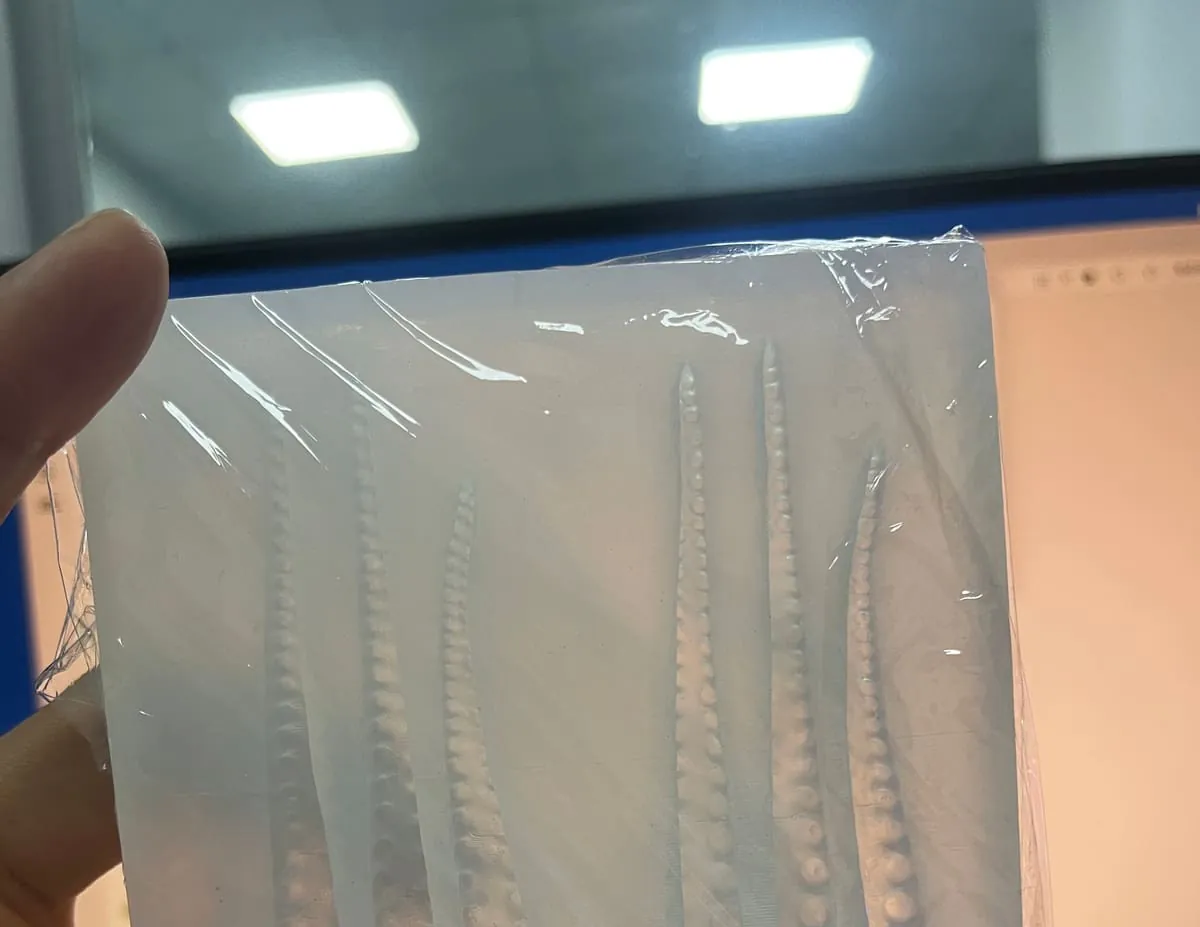
The photo that would prove the sequence: a stippled detail coat still wet in the lettering, then the same master with a body coat, then the jacket. A glossy catalog glove with no coat lines does not prove which sequence was used.
When a pour-on block still wins
Buyers ask for brush-on "to save silicone." On a 40 mm resin badge in a tight box, pour-on uses less labor and about the same gum once you count the wasted detail-coat cups and the jacket. Labor is the real line. We quote the sequence from the master envelope, not from a kit aisle labeled brush-on.
ISO 3302-1 M2 is a drawing class on the dump, not a coat-count. Platinum 0.1–0.3% shrink applies after a full cure of either sequence.
Shop numbers for coat vs pour
Reference values only. Confirm material-specific limits against the supplier’s technical data and agree project acceptance criteria before production.
| Item | Typical shop value |
|---|---|
| Cavity Shore | 10A–20A glove skin; 20A–40A shallow trays |
| Mix | 1:1 or 10:1 by weight (never by unmarked cup) |
| Platinum shrink | about 0.1–0.3% after full cure |
| Prototype | 3–7 business days after CAD lock |
| Production MOQ | 20 pieces per design |
| Simple 3D | USD $50 when that CAD scope applies |
| Loaded sag without jacket | about 0.5–1.5 mm |
Sequences we would not run
We would not recommend a single brush coat as a production mold for a weekly PU dump. Add body coats and a jacket, or pour a box.
We would not recommend brushing platinum over an unsealed SLA or sulfur clay "because brush-on is thinner and less likely to inhibit." Inhibition is chemistry, not thickness. Seal first — sealer on porous masters.
We would not recommend caulk-tube acetoxy silicone as a food or production skin.
We would not recommend pouring a 10 mm block when the RFQ needed a 2 mm skin plus jacket, just because pour-on was the default on the last job.
A tooling charge is not unrestricted ownership of the coated master. If we destroy a clay original in the box, say so before mix day.
Worked example: 420 mm panel that could not box
Architectural panel, 420 × 280 mm, deep stone texture, too large for a cheap flask. We stippled a platinum 15A detail coat, two body coats, plaster jacket in three pieces with keyed seams. Prototype 3–7 business days after CAD lock of the split lines (they had a mesh, not a STEP; USD $50 3D applied to rebuild the outline). Production MOQ 20 skins of that design, jackets as a separate line. A pour-on quote would have buried the panel in gum we did not need.
A second job: 12-up wax-melt tray. Pour-on open-back, no brush coat. Faster, cleaner face, less handling.
Mix-up: brush-on means "thixotropic kit" and pour-on means "1:1 kit"
Thixotropic additives turn a pourable platinum into a paste. You can brush a 1:1 grade after you add a thixotrope, and you can pour a 10:1 grade in a box. Ask for the *sequence* (detail coat vs box pour) and the *mix* (1:1 or 10:1 by weight) as two fields.
Questions that pick the sequence
- Can the master sit in a leak-tight box, or is it vertical / oversized?
- Do you need a thin glove plus jacket, or a block you can peel?
- What is the dump, peak °C, and monthly cycle count?
- Who keeps the master if a pour-on box would encapsulate it?
- CAD: millimetre STEP, or USD $50 3D if that scope applies?
Related: how to build a mold box, custom sculptures, contact.
RFQ copy-pack — pour-on vs detail coat
Paste into [email protected]:
Object: RTV mold I pour into, not an LSR/HCR part Master size (mm) and whether it can sit in a box Sequence you want: pour-on / detail coat + jacket / you mark it Dump material and peak °C Platinum mix 1:1 or 10:1 if you already spec a drum File: STEP / STL / photos with a millimetre scale CAD: mold-ready STEP OR USD $50 3D if that scope applies Prototype 3–7 business days after CAD lock, then MOQ 20 per design Who keeps the master
Send the envelope of the master, not "brush-on to save rubber." We pick sequence on the 2D — not a blank "free quote." Phone +86 135 3006 2969. Licheng Technology Industry Park, Xinhe Blvd, Shajing, Bao'an. Shop since 2018.
FAQ
Does brush-on use less silicone than pour-on? On a tall statue, yes. On a small boxed badge, labor and wasted cups often erase the gum savings. Quote the envelope.
Do I still vacuum a brush-on mix? Vacuum the cup if the grade allows, then brush. Whipping the detail coat in open air prints bubbles on the face.
Can I brush tin onto a dirty master and pour platinum over it later? Tin residue inhibits platinum. Do not stack chemistries without a barrier plan.
Is a glove mold automatically a two-part mold? No. A glove can be one piece. Two-part means a keyed split. Structure is a different call.
Will you brush a food-contact cavity? If the article needs 21 CFR 177.2600 / LFGB, we still use platinum and a wash path. Sequence does not replace documents.
Custom silicone development · DFM & prototype support
CAD, drawing, photos or sample details